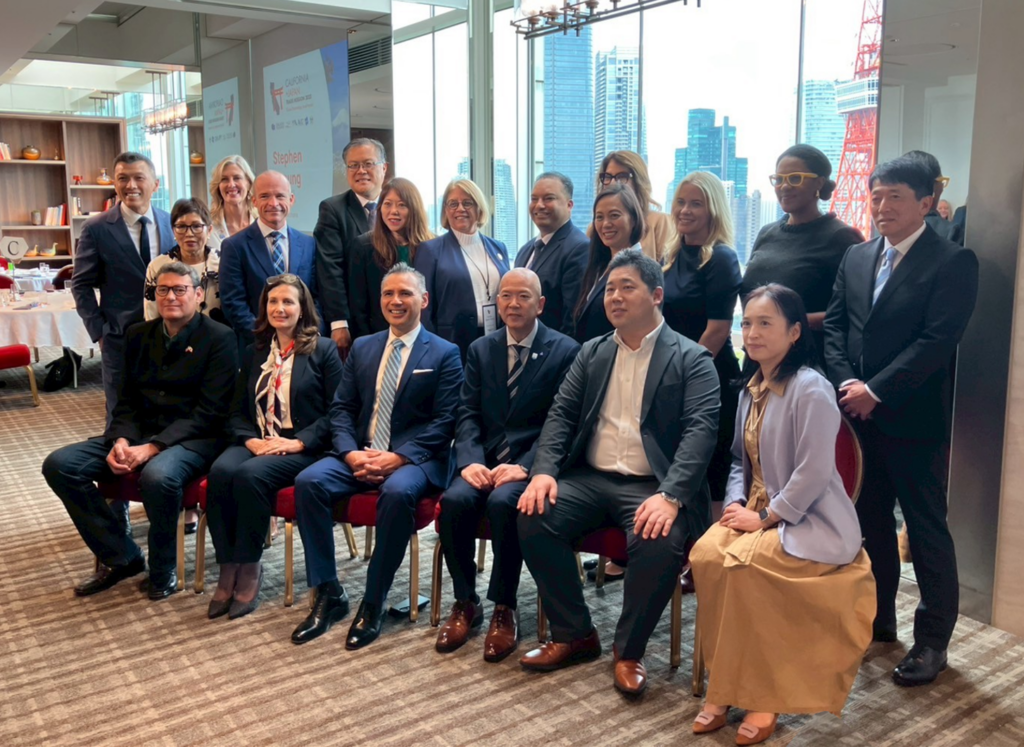
California’s leadership in sustainable trade took center stage in Tokyo on Sept. 29, 2025, during a California trade mission led by California State Treasurer Fiona Ma. The delegation brought together more than 50 delegates from the California legislature, port authorities and private industry for high-level talks with the Port of Yokohama on port resiliency and sustainability.
Representing Pacific Environment, Davina Hurt and Katsunori Hirano joined the 10-member delegation from the Port of Yokohama, led by Director General Yasuhiro Shimbo of the Port and Harbor Bureau of the City of Yokohama, to exchange ideas and strategies for building cleaner, more sustainable ports across the Pacific.
Three major California port authorities — the Port of Long Beach, Port of Los Angeles and Port of Hueneme — presented their ongoing efforts aimed at decarbonizing their respective ports. The city of Yokohama followed with a presentation, highlighting key strategies from its own port decarbonization plan launched in March 2025.
The event culminated in a forward-looking discussion between the three California ports and the Port of Yokohama for future collaboration. Top executives — including Noel Hacegaba, Chief Operating Officer of the Port of Long Beach; Dina Aryan-Zahlan, Deputy Executive Director of Development for the Port of Los Angeles; Jason Hodge, Port of Hueneme Commissioner of the Oxnard Harbor District; and Yasuhiro Shimbo — demonstrated a strong commitment to building lasting partnerships.
Pacific Environment played an active role in the event and aided in a constructive discussion post-event, particularly around alternative clean energy and the development of green shipping corridors: dedicated routes on which zero-emission ships and other carbon-reducing infrastructure are deployed. We witnessed the city of Yokohama’s strong commitment to collaborative efforts and the state of California’s leadership in advancing port decarbonization and climate-aligned trade.
This event marked an important step for Pacific Environment in strengthening trust with port leadership on both sides of the Pacific. Through continued engagement, we aim to advance a goal of fostering long-term communication and collaboration to reduce maritime emissions and promote clean energy through green shipping corridor initiatives and alternative fuel infrastructure. We remain steadfast in our support of visionary port authorities — including the Ports of Long Beach, Los Angeles and Hueneme, as well as the Port of Yokohama — as they work toward the shared goal of transitioning to resilient and sustainable ports.
Strategies and trends were also discussed during the trade mission. It is clear that Japan is pursuing a measured yet ambitious path toward maritime decarbonization. Some important points we learned during the mission include:
- Ammonia and methanol are emerging as leading alternative fuel strategies.
- Ports and shipyards are at the heart of national demonstration projects.
- Finance and industry coalitions are emerging as crucial enablers of progress.
- NGO networks are bridging private and public sectors to accelerate climate action.
- Japan is positioning itself as a regional “fast follower,” emphasizing safety, scalability and cross-sector governance.
The Japan-California trade mission re-affirmed the importance of ongoing face-to-face dialogue in managing the global transition toward clean maritime trade. We are deeply grateful to the city of Yokohama for welcoming us as part of the Port of Yokohama’s delegation and for the opportunity to contribute to this meaningful and timely dialogue.