Key takeaways
- The naming of Southeast Asia’s first fully electric tug EON marks another operational milestone for maritime electrification in Singapore.
- Kuok Maritime Group, through the Coastal Sustainability Alliance, is playing a decisive role in decarbonizing Singapore’s harbor craft fleet.
- Singapore’s progress on electrifying its domestic harbor craft fleet reflects sustained, coordinated work across ecosystem stakeholders.
- The focus now must shift from first vessels to fleet-wide adoption.
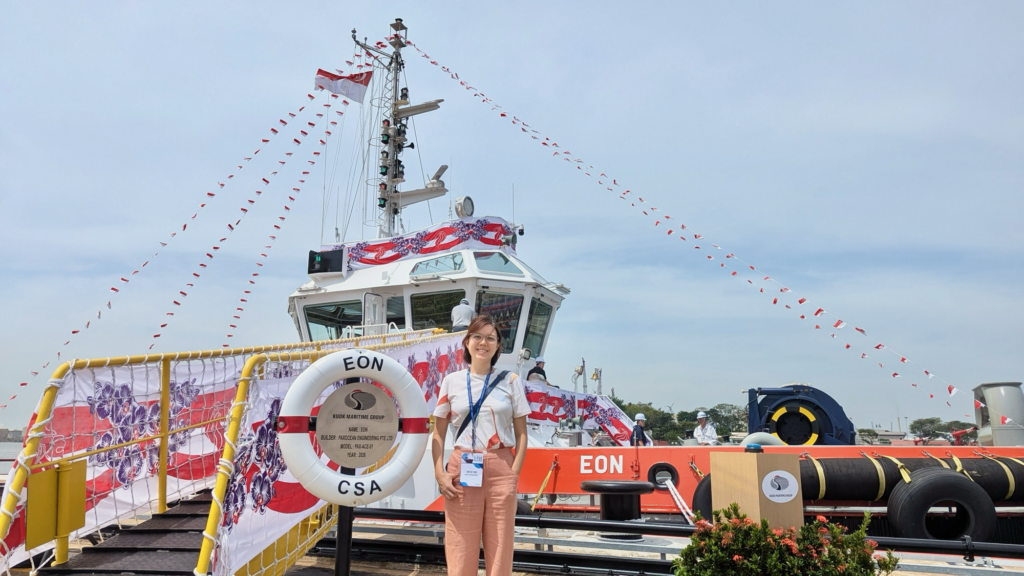
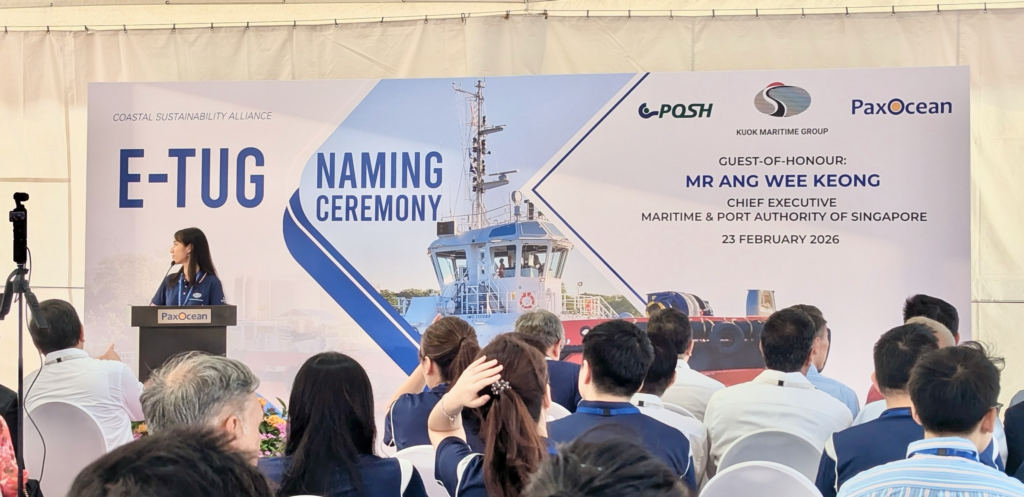
This week, I stood in a crowd of maritime industry leaders and government officials at PaxOcean’s new shipyard in Singapore at the naming ceremony of Southeast Asia’s first fully electric tug, the EON. This was a remarkable moment in the greening of Singapore’s harbor operations, and I was proud to witness it firsthand. An eon is time on a planetary scale, signifying impact that lasts generations.
The vessel is spearheaded by local firm Kuok Maritime Group (KMG) — the parent company of PaxOcean — through the Coastal Sustainability Alliance (CSA), an industry collaborative it leads. The 29-meter (approximately 95-foot), 50-ton tug features an integrated electric propulsion system from ABB, enabling lower energy consumption compared to conventional diesel-powered tugs. In addition, the vessel has been designed with spare capacity in the battery rooms to accommodate additional energy storage systems, while its architecture supports hybrid configurations that can incorporate alternative fuels such as ammonia and hydrogen. When these fuels become commercially available in the future, this will be another tipping point for the transformation of the domestic harbor craft sector in Singapore.
The launch of EON sends a clear signal: Industry is turning ambition into action and taking responsibility for delivering change on the water. Aptly described by PaxOcean Group’s CEO Mr. Tan Thai Yong at the ceremony, “This electric tug … moves sustainability from aspiration to operation. From discussion to deployment.”
Electrifying Singapore’s harbor fleet
Across Asia, companies are moving ahead of regulation to make harbor craft electrification a reality. Hybrid-electric tugs are already operating in Korea while Japan and China are rapidly advancing the development and deployment of electric and hydrogen-electric tugs. Within this regional shift, EON and CSA stand out as a leading example translating policy direction into operational reality and showing a clear path from first vessels to fleet-wide adoption.
Harbor craft are the workhorses of our ports. Tugboats, passenger ferries, cargo launches and other essential vessels operate day and night, close to shore, traditionally running on diesel in densely-populated waters. Loud and dirty, diesel has been around for centuries, but that is starting to change. With about 1,600 harbor craft operating in Singapore’s waters, electrifying the sector is paramount because it reduces carbon emissions, offers quieter operations to passengers and workers, improves local air quality and shows that the decarbonization of the maritime industry is no longer a distant ambition — it is here.
Underpinning this transition is MPA’s directive that all new harbor craft be fully electric or compatible with B100 biofuel or net-zero fuels such as hydrogen by 2030. The regulator is also steadily creating the conditions that are necessary to move the sector toward timely implementation, from setting new technical and safety standards to facilitating the deployment of charging infrastructure.
Industry leadership makes electrification possible
While MPA provides regulatory clarity and direction, turning intent into reality requires concerted collaboration across shipbuilders, owners, operators and technology partners. EON reinforces CSA’s pivotal contribution to decarbonizing Singapore’s harbor craft fleet. It also sends an unambiguous signal that industry is prepared not only to meet environmental ambitions, but to invest in solutions that deliver measurable impact while strengthening the long-term competitiveness and resilience of the maritime ecosystem.
Designing and operating an electric tug is challenging. It requires confidence in battery systems, maintenance regimes, crew training and evolving safety standards. The fact that CSA has achieved this is a testament to its ability to convene and rally partners in the national electrification drive. That’s leadership.
Building momentum for sector-wide decarbonization
Early movers matter in this industry. Every electric harbor craft like EON that enters service builds technical expertise, reduces perceived risk and makes the process of decarbonization a little easier for the next boat operator. Decarbonization advances not by mandate alone, but through solutions that demonstrate their value in real-world operations.
The next phase is about scale. Fleet-wide electrification will require continued industry commitment, from investing in clean technologies to upgrading charging infrastructure, strengthening supply chains and adapting operational models that prioritise long-term resilience over short-term cost.
Leading the next phase of maritime decarbonization
As a global maritime hub with a strong track record of execution, Singapore is well positioned to lead. In his speech, the chief executive of Singapore’s Maritime and Port Authority, Mr. Ang Wee Keong, highlighted that EON not only drives local change but also serves as a blueprint for regional and international adoption. On the policy side, while there are environmental risks associated with biofuel use, Singapore’s 2030 harbor craft requirement remains among the most progressive directives globally. The international maritime community is watching closely as these developments continue to unfold in practice.
Standing at the naming ceremony, I wasn’t just watching a new vessel enter service, I was seeing in real-time Singapore’s commitment to stay the course and a sector forging toward a shared direction. The responsibility now is to keep this momentum growing and to move Singapore into the place where it is meant to lead: a zero-emission, clean future.